lundi 24 août 2009

Utilities Bulk Up On Energy Storage

Bigger is better on the bulk system.

The United States is experiencing a major shift in energy policy, driven by the Obama White House. The Obama administration has launched a major push toward green energy, and that push is hitting all aspects of the energy industry: generation, storage and consumption.

The Obama administration also is pushing for a Smart Grid strategy to enable the industry to handle the collection, dispersion, storage and consumption of renewable energies. A $16 billion investment in Smart Grid incentives is projected over the next four years. That investment is estimated to drive $64 billion more in investment in Smart Grid-related initiatives, according to Ralph Masiello, senior vice president, Energy Systems Consulting, KEMA Inc. (Arnhem, the Netherlands). Key to the success of the Smart Grid will be the customer's ability to deploy energy-saving technologies, and that is one arena where energy storage comes into play.

A tremendous opportunity exists for utilities to add bulk-energy storage rather than continue adding new generation to meet the expected growth in peak loads. Case in point: California. The California Energy Commission predicts the statewide annual peak will grow at an average 850 MW per year over the next 10 years, during which the overall utilization from individual power stations is expected to decline. It seems like utilities are expecting less of their facilities on average while building new plants to meet peaks driven largely by the net summer generation peak.

Energy Storage Is Not New

Unfortunately, there is a gap between the vision of storing large amounts of off-peak power and the technology of bulk-energy storage. For the past 100 years, large-scale energy storage meant pumped-storage hydroelectric systems. They were all that was available, and utilities certainly took advantage of the technology.

According to the Electricity Storage Association (Morgan Hill, California), pumped hydro storage accounts for more than 90 GW of energy storage worldwide. The U.S. has roughly 150 pumped hydro facilities in 19 states, with about 22 GW of installed capacity. It is a fairly simple technology but expensive with long construction times.

Energy is stored in the form of water. There are two water reservoirs separated vertically (one low-elevation reservoir and one high-elevation reservoir). During off-peak hours when electricity is cheaper, reversible turbines are used to pump water from the lower reservoir to the higher reservoir. When the system needs electricity, the plant releases the water from the upper reservoir to flow through the hydro turbines, which generate electricity.

The typical duration of discharge ranges from eight hours to 24 hours, depending on the size of the storage reservoir. Pumped-storage projects have a fairly fast reaction time, taking about 10 minutes on average to go from being completely turned off to producing full power. Capacities range from a few hundred megawatts to more than 2 GW. Construction can take more than 10 years, sites are very geographically specific and obtaining environmental permits can be a real challenge.

Compressed-Air Storage

About 20 or so years ago, compressed-air energy-storage (CAES) technology came on the scene. CAES uses off-peak generation to compress air adiabatically — using coolers to remove the heat caused by compression — into a reservoir located either aboveground or belowground. When the peak builds, the compressed air is released (much like the water in a pumped hydro system), heated (the exhaust from a standard combustion turbine) and passed through an expansion turbine to drive the generator.

There are currently two CAES plants in operation. In service since 1978, the first CAES plant is located in Huntdort, Germany. It is rated at 290 MW and owned by EN Kraftwerke. Built in 1991, the second plant is located in McIntosh, Alabama. It has a rating of 110 MW for 26 hours and is owned by Alabama Electric Cooperative. Both plants inject air into underground caverns excavated from salt formations. The plants have been very reliable plants and led to many innovations in the next generation of CAES plants.

The Electric Power Research Institute (Palo Alto, California) has several pilot projects under development for the deployment of second-generation CAES facilities. They are expected to be in the 100-MW to 300-MW range with a 10-hour capacity. The first-generation plants used a very complex turbo machinery, combined motor-generator and custom components. The advanced plants are much simpler, use more-standard components and have separate motors and generators. The second-generation plants are also more efficient than their predecessors.

CAES technology has changed in recent years to include adiabatic storage. The heat of compression is also stored and returned to the air when it is expanded, which greatly improves the efficiency of the process. Another innovation being pursued by EPRI is the use of large-diameter pipes for the compressed-air reservoir. The pipe system is placed in a transmission line's right-of-way. This moves CAES from specific geographical sites to any place a transmission line exists.

Solar Storage

A recent technology gaining interest for bulk-system storage is concentrating solar power (CSP), which is a thermal energy storage (TES) technology. CSP systems use specially shaped motor-driven mirrors to track the sun's movement. They focus the sun's energy on towers or pipes containing a thermal storage medium (air, oil, water or salt), which is heated to extreme temperatures to generate steam for generation electricity. The thermal medium is heated by the sun's energy and stored in an insulated tank.

By storing energy as heat, the thermodynamic efficiency of TES is fundamentally higher than alternatives that require conversion. The result of TES is that solar generation can be made to be dispatchable and can produce electricity long after the sun has set or during periods of cloud cover.

Arizona Public Service (Phoenix, Arizona) has announced a project with the Spanish firm Abengoa for a 250- MW CSP plant that will be equipped with five to six hours of thermal energy storage. In addition, several CSP plants with molten-salt energy storage are operating or under development in Spain.

“Molten-salt thermal energy storage holds considerable promise for several reasons,” said Eric John, vice president, Electric Utility Projects, SkyFuel Inc. (Albuquerque, New Mexico). “First, it has a capital-cost profile in terms of dollar per kilowatt-hour similar to pumped hydro and CAES. Secondly, molten-salt TES does not have any geographic limitations or requirements like pumped hydro or CAES, and can be deployed anywhere a CSP plant is sited. Finally, the salt-storage material is environmentally benign and does not suffer performance degradation over time.”

Exotic Battery Chemistry

Of course, the mature technology of lead-acid and nickel-cadmium batteries has been used in large energy-storage systems and can't be neglected in the category of bulk storage. Granted, capacities near 50 MW are not large in the sense of bulk-power requirements, but their position is secure because of their sheer number. Worldwide, about 40% of all energy-storage systems are battery based, and advances in technology continue to put batteries in a strong position. A new battery chemistry gaining a great deal of attention is constructed from sodium and sulfur (NaS).

The NaS battery was originally developed by Ford Motor Co. (Dearborn, Michigan) to power its Ecostar electric vehicle. However, it was better suited for a stationary battery application. NGK Insulators Ltd. (Nagoya, Japan) and Tokyo Electric Power Co. (TEPCO; Tokyo, Japan) refined the technology for utility applications.

The NaS battery has three times the energy density of a lead-acid battery and a longer life span. NaS batteries are made up of a cylindrical electrochemical cell that contains a negative molten-sodium electrode and a positive molten-sulfur electrode. In order to keep the sodium and sulfur molten in the battery, and to obtain adequate conductivity in the electrolyte, they are housed in a thermally insulated enclosure. The enclosure must be kept above 270°C, usually from 320°C to 340°C.

NGK and TEPCO have deployed a number of large-scale demonstration projects around the world. To date, they have more than 196 large-scale NaS systems with roughly 270 MW installed globally. These include two 6-MW 48-MWh batteries.

In 2006, American Electric Power (Columbus, Ohio) installed a 1-MW, 7.2-MWh NaS battery on a substation feeder. The installation deferred the building of a new substation for about three years. In 2008, American Electric Power installed 2-MW 14.4-MWh NaS batteries in Ohio, West Virginia and Indiana.

The NaS system is characterized by being able to provide a single continuous discharge or shorter-larger pulses. It is also able to pulse in the middle of a long-term discharge and capable of a high number of charge/discharge cycles (more than 3000). With NaS battery installations growing in capacities, the technology has moved from pilot projects to commercial applications.

Making Bulk Storage A Reality

In a perfect world, there would be no peaks of demand or valleys of under-utilization. The load profile would resemble gentle rolling hills rather than Mount Everest and its foothills.

Utilities have long recognized that the ability to store large amounts of cheap off-peak electricity for later use on the grid could go a long way to achieving that goal. Instead of curtailing generation when the sun goes down, it should be used by bulk-energy-storage systems for later use. It may sound like Pollyannaism, but we have the technology, and it needs to be deployed.

Small-Scale Nuclear

Just as pumped hydro can be looked at as storage, might small nuclear also be looked at in the same vein? With small-scale nuclear, utilities could feed wind and solar into the grid when available and use small-scale nuclear as a back up with small-scale nuclear.

Is the thought of small-scale nuclear far-fetched? Not according to Dr. Otis Peterson, a physicist at Los Alamos National Laboratory. Peterson has taken the lead in developing what is now called the Hyperion Power Module. Hyperion Power Generation (Santa Fe, New Mexico) has several more years of work before the power module can be manufactured in volume.

The device is being developed in 25-MW units called “Hyperion 20 MW Nuclear Power Modules.” The device, which could supply power to approximately 20,000 homes, is basically a hot tub full of uranium hydride with some hydrogen and some heat-exchange rods. The tub of properly prepared materials regulates itself while generating electricity. The company has received 100 orders, according to the U.K.'s Guardian newspaper, and intends to set up three factories to produce 4,000 units between 2013 and 2023.

The nuclear portion of the generation is self-contained and is measures 0.5 ft tall by 6 ft wide. The device is transportable via train, ship or truck. Each module will operate for five to 10 years depending on output and the units can be refueled at the original factory. The device uses low-enriched uranium fuel with no mechanical parts in the core. Because water is not used as coolant, the unit cannot go supercritical or get too hot.

The safety and security of these power modules is not being neglected. Hyperion intends to file a license application for the design with the U.S. Nuclear Regulatory Commission (NRC) in late 2009. The NRC will then review the design while Hyperion continues with product development and testing to show that the device safely meets market requirements.

Hyperion expects that early on, most customers will be from outside the U.S. and thus will seek and conform to local regulatory authorities in those countries considering small-scale nuclear.

On the drawing board are two other small-scale nuclear devices that use traditional solid low-enriched uranium as fuel. Toshiba also has also been developing a portable reactor, dubbed Rapid-L, which uses liquid lithium-6 as coolant and moderator. Similarly, the Department of Energy's Lawrence Livermore National Laboratory has a SSTAR (Small, Sealed, Transportable Autonomous Reactor) design that uses liquid lead hydride.

Solar-to-salt energy start-up gets $140 million in financing

September 19, 2008 | 4:00 am

From Times staff writer Edward Silver:

Money may be evaporating on Wall Street, but $140 million is on its way into the accounts of a promising Santa Monica-based solar start-up.

SolarReserve, an offshoot of aerospace giant Rocketdyne, tackles the challenge of intermittency -- storing energy when the sun don’t shine.

At the core of the utility-scale solution is a simple substance: salt, specifically a combination of sodium and potassium nitrate. It’s the inventive way the salt is used that prodded venture investors to reach for their checkbooks this week to provide second-round financing for the firm.

Saltshaker_2In SolarReserve’s blueprint, arrays of specialized mirrors, called heliostats, track the sun’s path and concentrate the heat on receiving towers that turn the salt molten. The salt holds its heat long enough to enable electric power companies to shift their output to peak times or nighttime. That power can fetch a premium price when demand is most intense and coal typically fills the bill.

Chief Executive Terry Murphy plugs the flexibility of the system, a traditional weak spot for renewables: "If you put energy into molten salt, you can store it in an insulated tank and use it on demand. We liken it to pumped solar," he said.

The technique proved itself in the Solar Two test project in the California desert, sponsored by the Department of Energy. Rocketdyne crafted some of the key technology for Solar Two and will equip SolarReserve’s expansive plants.

Rocketdyne, the Canoga Park unit of United TechnologiesCorp., has a storied history with the space shuttle and Apollo projects, flashing credibility in the minds of its offshoot’s financiers.

SolarReserve sees itself as the commercializer. The firm is studying sunny patches in the U.S. and Europe as potential generation sites. Though utilities just about everywhere are eager to bring more solar online, Murphy sees the Mediterranean region as more fertile ground than California. That’s partly because governments there cut better deals. In this country, the production tax credit is in limbo, and there’s no shortage of permitting hitches in California, he says.

The start-up has plenty of planning and building ahead of it. Murphy’s target for power to the grid is late 2012 or early 2013.

U.S. Renewables Group, SolarReserve’s founding investor, is near the firm on Olympic Boulevard. Other backers include Citi Alternative Investments, Sustainable Development Investments,Good Energies and Credit Suisse.

Photo: Pour it in, power up. Kirk McKoy / Los Angeles Times

Solar Venture Will Draw on Molten Salt

WINDSOR LOCKS, Conn. -- United Technologies Corp.'s Hamilton Sundstrand unit, more commonly known as a major supplier of components for the aerospace industry, believes it can draw on lessons learned from a 25-year-old science project to help change the way electric power is generated.

Hamilton Sundstrand is scheduled to announce today that it has teamed with US Renewables Group to commercialize a new type of solar-power plant that will use molten salt to store the sun's heat so it can be converted to electrical power even when the sun isn't shining. Company officials say rising fossil-fuel prices have made it possible for such plants to be competitive, particularly for generating electricity during periods of peak demand when utility companies pay premium prices. US Renewables Group is a $575 million private-equity firm that specializes in renewable-power and clean-fuel projects.

[graphic]

"We think there's a huge market out there," said David Hess, president of Hamilton Sundstrand, which reported 2006 segment revenue of $5 billion. Mr. Hess estimated that Hamilton Sundstrand can generate a total of about $1 billion in sales of solar-power equipment in the next 15 years.

The solar-power business is the latest in a string of developments for a United Technologies unit that rarely receives attention when compared with its big-name corporate siblings such as Otis (elevators), Carrier (air conditioning) and Pratt & Whitney (jet engines). Although Hamilton Sundstrand generates about one-third the revenue of Otis or Carrier, it has chalked up some big wins on important airplane programs that have helped it become one of the leading names in aerospace.

Hamilton Sundstrand got a boost when it won contracts for a majority of specialized systems onBoeing Co.'s 787 Dreamliner, upsetting previously dominant rivals such as Honeywell International Inc. Hamilton's equipment content on the 787 alone totals about $2.5 million per airplane, with orders for 790 planes on the books.

The company also won key roles in providing equipment for European Aeronautics Defence & Space Co.'s Airbus A380 and A400M and for Embraer Empresa Brasileiras de Aeronautica SA's ERJ 170 and 190 regional jets. It supplies systems for the National Aeronautics and Space Administration's Orion crew vehicle being developed for the planned return of astronauts to the moon.

Hamilton Sundstrand officials say the solar-power business will be managed through a new entity called SolarReserve, which will hold the exclusive license to market and operate utility-scale solar-power plants world-wide. Under the agreement with US Renewables Group, Hamilton Sundstrand's Rocketdyne segment will provide heat-resistant pumps and other equipment, as well as the expertise in handling and storing salt that has been heated to more than 1,050 degrees Fahrenheit. The company says plants using this method will be able to generate as much as 500 megawatts of peak power or run continuously at 50 megawatts. One megawatt is enough power to supply about 1,000 U.S. households.

"Due to the unique ability of the product to store the energy it captures, this system will function like a conventional hydroelectric power plant, but with several advantages," said Lee Bailey, managing director of US Renewables Group. "This product is more predictable than water reserves, the supply is free and inexhaustible, and the environmental impact is essentially zero."

Mr. Bailey said US Renewables has invested in geothermal, biomass and other environmentally friendly power projects, but it hadn't found an appropriate solar technology until it learned of Rocketdyne's method of using molten salt to hold heat. According to the company, molten salt loses only about 1% of its heat during a day, making it possible to store energy for long periods of time. The salt is a mixture of sodium and potassium nitrate.

The solar-plant technology was first demonstrated by Rocketdyne in the 1980s, using the sun's heat to convert water into steam to drive generators. In 1994, the project was modified to include the use of molten salt for energy storage. In such a system, the molten salt is pumped through a tower, where it is heated by the sun's rays. The salt is then stored in insulated containers until it is needed. It is then used to convert water into steam that drives turbines that generate electricity. The solar demonstration project was decommissioned in 1999.

United Technologies bought the Rocketdyne business from Boeing for $700 million in 2005 and split up the unit's businesses among Pratt & Whitney and Hamilton Sundstrand.

While it might be promising for some areas, so-called concentrated solar-power stations will likely represent only a small part of the world's power-generation needs. They are most suited for regions that have a combination of predominantly sunny climate and large open spaces that can handle the 1,200-acre field of mirrors, called heliostats, needed to reflect the sun's energy to a 600-foot tower that houses the receiver for collecting the sun's energy. Ideal locations include the U.S. Southwest as well as southern Europe, Australia and Africa.

In November, the U.S. Energy Department said it would provide $5.2 million in funding to support the development of low-cost concentrated solar power such as that being advocated by SolarReserve. An additional $7.2 million has been earmarked to support commercialization of clean energy technologies.

Write to J. Lynn Lunsford at lynn.lunsford@wsj.com

mercredi 19 août 2009

8 Energy Storage Stocks that Can Expect Explosive Growth

In August of last year I wrote an article titled "Grid-based Energy Storage: Birth of a Giant." Over the last 12 months I've written a series of follow-on articles that discuss the principal classes of manufactured energy storage devices and the companies that are making or planning to make products for smart grid energy storage applications. My entire archive of articles on the energy storage sector is available here.

One of the biggest problems I've encountered over the last year has been a dearth of reliable third party information that can help investors understand the breadth and depth of the business opportunity, and sift through the frequently contradictory claims of energy storage device manufacturers that plan to target the smart grid as a principal market. Since energy storage investors are generally well-informed and frequently opinionated, most of my articles have lengthy comment streams that round out my perspective and are usually more interesting than the articles themselves.

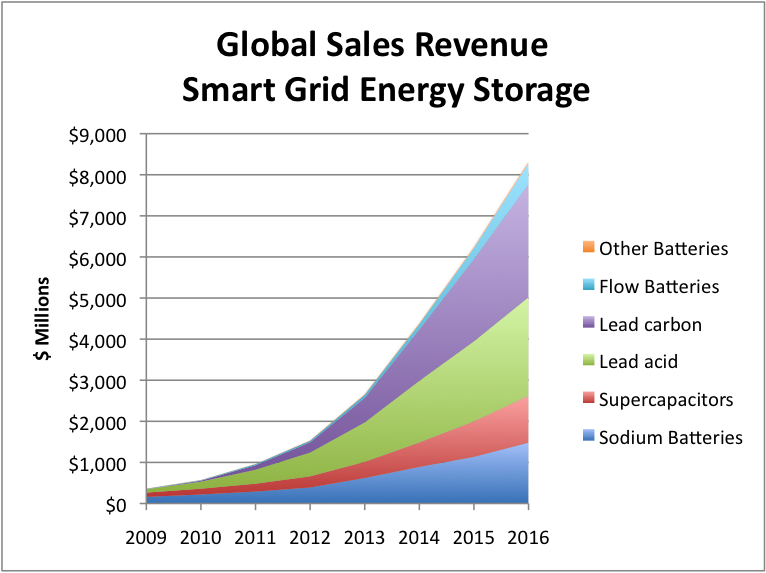
Two weeks ago I ran across a story on greentechgrid that said NanoMarkets LLC, a leading market research firm from Glenn Allen, Virginia, was predicting that the global market for storage batteries and ultracapacitors on the smart grid would grow from its current level of $326 million to $8.3 billion by 2016. Since the market size and growth rate estimates were very impressive and I track many of the companies identified in the greentechgrid story, I contacted NanoMarkets to see if they would send me a complimentary copy of their report.

A little over a week ago I received a copy of NanoMarkets 102 page report titled "Batteries and Ultra-Capacitors for the Smart Power Grid: Market Opportunities 2009-2016." I've been like a kid in a candy store ever since. While the $2,995 report is a little pricey for individual investors, it's a must read for institutions and other large investors that are analyzing opportunities in the energy storage sector. It's also a wonderful planning tool for companies that are developing go to market strategies for manufactured energy storage devices. Individuals who want to better understand how the smart-grid market is likely to develop and grow over the next several years can gain important insight from a free June 2009 NanoMarkets white paper titled "Plug In to Materials Trends for Smart Grid Applications." NanoMarkets has agreed to offer a $500 discount on the full report to my readers who contact Robert Nolan (rob@nanomarkets.net) and mention this article.

Unlike forecasts from storage device manufacturers and stock market analysts who tend to focus on how a particular product, technology or company might fit in an emerging market, NanoMarkets approached the issue of smart grid storage from the end-user's perspective; meaning that they identified the customer's needs first and then focused on the companies that had cost-effective solutions for those needs. The principal near-term applications identified by NanoMarkets are:

  • Load leveling and power quality systems to protect commercial and industrial users from brief power interruptions that cost an estimated $75 to $200 billion per year in lost time, lost commerce and damage to equipment;
  • Peak shaving systems to help commercial and industrial users manage their electricity costs under variable utility tariffs and help utilities manage generating assets to minimize waste;
  • Transmission and distribution support systems to help utilities reduce grid congestion, defer upgrades and minimize waste; and
  • Renewables integration systems to help power producers, utilities and end users cope with the inherent variability of wind and solar power and better match peak wind and solar output with peak demand.

In evaluating the likely development path for energy storage devices on the smart grid, NanoMarkets considered a variety of competing technologies including pumped hydro, compressed air, flywheels, chemical storage batteries, ultracapacitors and superconducting magnets. They ultimately concluded that:

  • Pumped hydro and compressed air had limited growth potential because of geographical and geologic constraints;
  • Flywheels and superconducting magnets were not likely to be widely used beyond niche applications because of their cost and complexity; and
  • Absent a revolutionary breakthrough in cycle life and cost, lithium-ion batteries will have limited application in the smart grid.

From my perspective one of the most refreshing aspects of the NanoMarkets report was their belief that storage systems for the smart grid will be chosen based on fundamental cost-benefit analysis. Equally important was their conclusion that emerging technologies would increase the overall demand for storage and result in rapidly increasing revenue for all product classes. So instead of facing a situation where an emerging technology takes sales away from an established technology, each class of technology can expect rapid sustained growth over the entire forecast period. When the forecasts for individual product classes are stacked on top of each other, it's easy to see why I believe the smart grid storage market will reach explosive growth rates by 2016. The following graph provides a consolidated summary of NanoMarkets' forecast for each of the principal battery classes over the next eight years.


I can't begin to do the NanoMarkets report justice in the limited confines of a financial blog. They thoroughly discuss the economic drivers and development path for each of the principal smart grid markets; carefully review each of the energy storage technologies that have significant potential in the smart grid market; identify the leading developers of energy storage devices for the smart grid; and break their sales forecasts down by both specific applications and geography. If NanoMarkets' forecast is even close to being right, the next decade will be a period of explosive growth for:

  • Sodium battery manufacturers like NGK Insulators (NGKIF.PK) and General Electric (GE) that can look for annual revenue in their sub-sector to grow by $1.3 billion over the next eight years;
  • Supercapacitor manufacturers like Maxwell Technologies (MXWL) that can look for annual revenue in their sub-sector to grow by $1 billion over the next eight years;
  • Lead-acid battery manufacturers like Enersys (ENS), Exide (XIDE) and C&D Technologies (CHP) that can look for annual revenue in their sub-sector to grow by $2.4 billion over the next eight years;
  • Lead-carbon battery manufacturers like Furukawa Battery (FBB.F), Axion Power (AXPW.OB) and Firefly that can look for annual revenue in their sub-sector to grow by $2.75 billion over the next eight years; and
  • Flow battery manufacturers like ZBB Energy (ZBB) that can look for annual revenue in their sub-sector to grow by $499 million over the next eight years;

For energy storage investors who truly want to understand where the smart grid energy storage device market is today and how it is likely to develop through 2016, the NanoMarkets report could well prove to be the soundest investment of all.

DISCLOSURE: Author is a former director Axion Power International (AXPW.OB) and holds a large long position in its stock. He also holds a small long positions in Enersys (ENS), Exide (XIDE) and ZBB Energy (ZBB).